All categories

Civilian Internees

Civilian internees at Santo Tomas Internment Camp, Manila

Civilian internees at Santo Tomas Internment Camp in Manila, where more than 4,000 American and Allied civilians were held until the camp's liberation in February 1945.

National Archives. Public domain.

When the Philippines, Hong Kong, Singapore, and other territories fell in 1941 and 1942, Japanese forces interned thousands of American and Allied civilian women across the Pacific, holding them for the length of the war in camps where food, medicine, and space ran out and never came back. At the same time the United States was confining its own: more than 110,000 people of Japanese descent, most of them American citizens, were removed from the West Coast and held behind wire in War Relocation Authority camps, the women and children among them. In Europe, the women caught inside the occupied countries met a different fate, or several: displacement, forced labor, internment, and in many cases deportation into the concentration camp system.
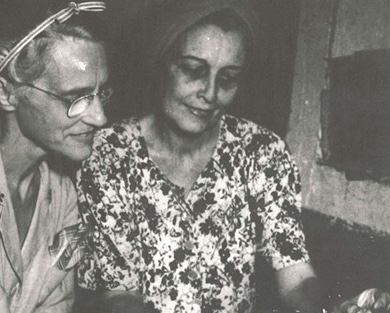
Natalie Stark Crouter

1898 to 1985

American civilian internee, Camp Holmes (Baguio) and Manila.

Crouter kept a daily record on scraps of paper hidden away throughout her family's three and a half years of internment in the Philippines, noting the slow starvation, the births and the deaths, and the small acts of endurance inside the camp. She and her family survived to liberation in 1945.

Tressa R. Cates

1903 to 1991

American civilian nurse; internee at Santo Tomas Internment Camp.

Cates, a civilian nurse working in Manila when the Japanese invaded, was held in Santo Tomas for the duration of the occupation, where she went on nursing the sick and concealed her wartime diary inside a drainpipe to keep it from camp searches. She was freed when American forces liberated the camp in February 1945.

Mitsuye Endo

1920 to 2006

Japanese American incarceree; plaintiff in Ex parte Endo before the U.S. Supreme Court.

A California state employee from Sacramento who had never been to Japan, Endo was fired and incarcerated after Pearl Harbor and held at the Tule Lake and Topaz camps run by the War Relocation Authority. When lawyers challenged her detention, the government offered to free her if she would stay away from the West Coast, and she refused, choosing to remain confined so the case could go forward. On 18 December 1944 the Supreme Court ruled in Ex parte Endo that the government could not keep holding a citizen it conceded was loyal, the decision that opened the way for the camps to close.

Margaret Coalson Sherk Sams

1916 to 2003

American civilian internee; Santo Tomas and Los Baños Internment Camps.

Sams was interned with her young son while her husband endured the Bataan Death March and his own imprisonment. She survived three years in the Santo Tomas and Los Baños camps, including the final stretch of near-starvation before the liberation of early 1945.

Researched and written by · Fortitude Research

Work with Erin

Tell me who
you are looking for.

Start the search About Erin