All categories

Code Breakers and Cryptanalysts

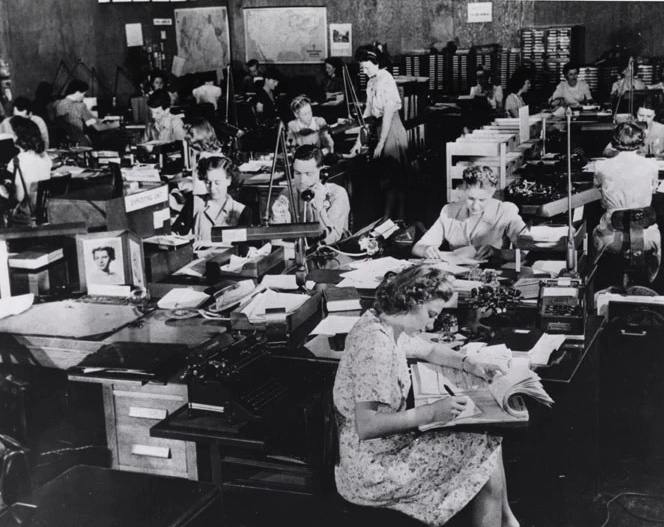
US Army Signal Intelligence Service cryptologists at Arlington Hall, circa 1943

US Army Signal Intelligence Service cryptologists at Arlington Hall Station, Virginia, circa 1943.

US Army Signal Corps, National Archives. Public domain.

More than 10,000 American women broke codes during the war, most of them at Arlington Hall in Virginia and the Naval Communications Annex in Washington. They cracked Japanese diplomatic ciphers and German Enigma traffic and laid the groundwork on the Soviet messages later read in the Venona project. Some of the most consequential breaks of the entire war were theirs, and the secrecy held for decades after the fighting stopped. Across the ocean, the women of Bletchley Park did the same work in the same years.
Genevieve Grotjan Feinstein

1913 to 2006

Cryptanalyst, US Army Signals Intelligence Service.

A 1936 mathematics graduate of the University of Buffalo, Grotjan was hired by William Friedman into the Signals Intelligence Service in 1939. On 20 September 1940, she identified the recurring patterns in intercepted traffic that allowed Frank Rowlett's SIS team to reconstruct the Japanese diplomatic cipher machine known to the Americans as Purple. She later contributed to the Venona project on Soviet intelligence traffic and was inducted into the NSA Hall of Honor in 2011.

Elizebeth Smith Friedman

1892 to 1980

Cryptanalyst, US Treasury, Coast Guard, and Navy.

Friedman trained as a literary scholar at Hillsdale College before joining George Fabyan's Riverbank Laboratories, where she and her future husband William Friedman pioneered American cryptanalysis. In 1931 she was put in charge of the US Coast Guard cryptanalysis unit, the only American codebreaking unit ever led by a woman. During WWII her team broke clandestine Nazi spy ring communications operating out of South America.

Joan Elisabeth Lowther Clarke Murray

1917 to 1996

Cryptanalyst, Bletchley Park Hut 8.

Clarke was a mathematics student at Newnham College, Cambridge, when her supervisor Gordon Welchman recruited her to the Government Code and Cypher School in June 1940. Assigned to Hut 8 under Alan Turing, she became the only woman known to have practiced Banburismus, the cryptanalytic technique used to attack German naval Enigma traffic. She was appointed MBE in 1946 and remained at GCHQ in the postwar period.

Agnes Meyer Driscoll

1889 to 1971

Cryptanalyst, US Navy.

Driscoll earned a B.A. in mathematics and physics from Ohio State University in 1911 and enlisted in the US Navy in 1918 as a chief yeoman. She helped break the Japanese Navy's Red Book code in 1926 and contributed to the breaking of the Blue Book code in 1930. In 1939 she made early progress against JN-25, the Imperial Japanese Navy's main operational code.

Researched and written by · Fortitude Research

Work with Erin

Tell me who
you are looking for.

Start the search About Erin