All categories

Resistance Fighters

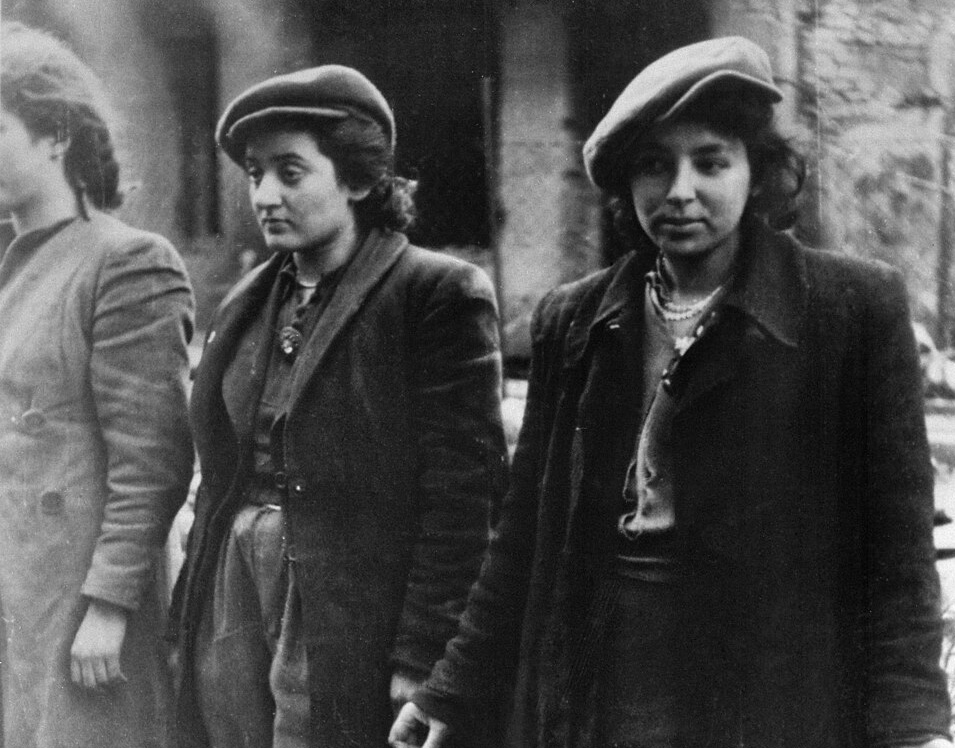
Three women fighters of the Warsaw Ghetto Uprising, 1943

From right to left: Małka Zdrojewicz Horenstein (survived internment at Majdanek), Bluma Wyszogrodzka (shot), and Rachela Wyszogrodzka (deported to Majdanek; died in the camps). Warsaw Ghetto Uprising, 1943.

Stroop Report photograph, Warsaw Ghetto, 1943. Public domain.

Women fought the occupation across Europe, in the western escape lines and in the Jewish ghetto uprisings and partisan bands of the east. They carried messages and hid Allied airmen, sabotaged German operations and gathered intelligence, took up arms against the occupiers, and fought inside the ghettos as they burned.
Mildred Fish-Harnack

1902 to 1943

American-born member of the Berlin resistance circle later known as the Red Orchestra.

Born in Milwaukee, Fish-Harnack moved to Germany in 1929 with her husband Arvid Harnack and taught literature in Berlin. Through the 1930s the couple built an underground circle that opposed the Nazi regime and passed intelligence to its enemies, the network the Gestapo would later call the Red Orchestra. She was arrested with her husband in September 1942. After a first sentence of six years, Hitler personally ordered her retried, and she was condemned to death and beheaded at Plötzensee Prison in Berlin on 16 February 1943, the only American woman executed on Hitler's direct order.

Sophie Magdalena Scholl

1921 to 1943

German student; White Rose non-violent resistance group.

Scholl was a student of biology and philosophy at the University of Munich and one of the core members of the White Rose, a small circle of students who wrote and secretly distributed leaflets calling on Germans to resist the Nazi regime. On 18 February 1943, she and her brother Hans carried a case of the group's sixth leaflet into the university and left stacks outside the lecture halls. Before leaving, Sophie pushed the last copies from a balustrade into the atrium below, a custodian saw her, and the two were turned in. The Gestapo interrogated her for days, and she took as much of the blame as she could to shield the others. On 22 February she was tried for treason before the People's Court under Roland Freisler, condemned, and guillotined at Stadelheim Prison in Munich that same afternoon, at the age of 21. She went to her death with a composure that has kept her among the most remembered faces of German resistance.

Zivia Lubetkin

1914 to 1978

Co-founder, Zydowska Organizacja Bojowa (ZOB); Warsaw Ghetto Uprising.

Lubetkin joined the Freiheit (Dror) Zionist youth movement and after the German invasion crossed back from Soviet-controlled territory to organize resistance in occupied Poland. She was one of the founders of the Jewish Fighting Organization (ZOB) and a member of its command, fought in the January and April 1943 Warsaw Ghetto uprisings, and on 10 May 1943 escaped through the sewers with the last of the fighters. She helped found Kibbutz Lohamei HaGetaot in Israel and testified at the Eichmann trial in 1961.

Andrée Dédée de Jongh

1916 to 2007

Belgian resistance organizer; founder of the Comet Line.

De Jongh founded and ran the Comet Line, an escape network that smuggled downed Allied airmen out of occupied Belgium, through France, and across the Pyrenees to neutral Spain. She personally guided 118 of these men toward the border before her arrest on 15 January 1943, and survived imprisonment at Ravensbrück and Mauthausen. After the war she spent decades nursing patients in leprosy hospitals in the Belgian Congo and later Ethiopia.

Researched and written by · Fortitude Research

Work with Erin

Tell me who
you are looking for.

Start the search About Erin